Survivor Engagement
This section will outline recommended behavior during encounters with other survivors. Feel free to adopt and modify this guideline depending on your situation.
HEROs are sworn to attempt diplomatic contact first and do not initiate attacks against survivors, but will react with forceful deadly precision if necessary.
Communication Setup (Mumble)
HEROs should setup 2 separate “push to talk” buttons for voice communication. Also setup a Shout/Whisper button. Larger HERO squads will need to buddy up and communicate frequently with buddies without too much cross talk to the whole squad.
Here is a working example of Mumble shortcut keys and their description:
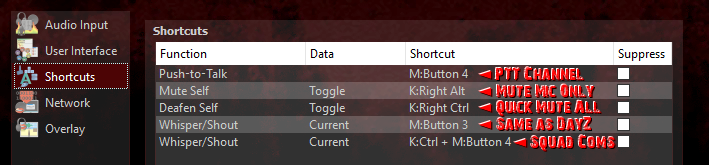
- Push-to-Talk – This is a standard push to talk that will chat in your current channel. If you are in a larger HERO squad, this will talk to your immediate buddy channel and NOT the entire squad.
- Deafen Self – This is a quick button to silence all of Mumble’s communication.
- Whisper/Shout – Same button as DayZ in-game voice chat so that the entire squad can hear your in-game voice chat if you need to chat with an unknown survivor. (See below for more details)
- Whisper/Shout – This is a different button than DayZ in-game voice chat to shout to the whole squad across linked channels. (See below for more details)
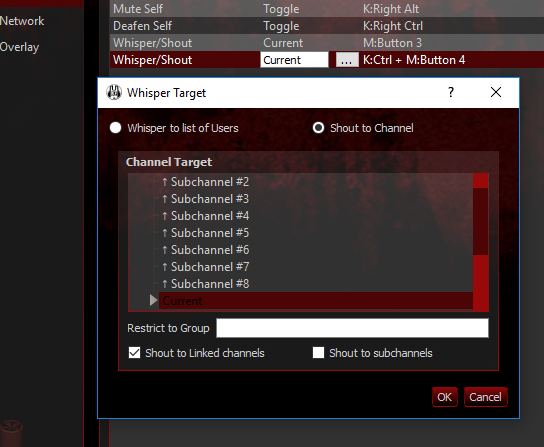
When you setup a Whisper/Shout command, make sure that you set it up like the above picture:
- Select “Shout to Channel”
- Channel Target: Current
- Check “Shout to Linked channels”
Mumble Custom Skin

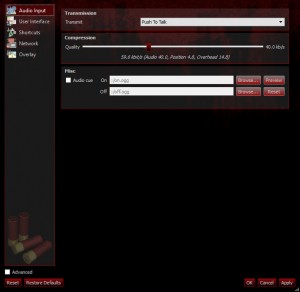
To install the custom Mumble skin:
- Download the DayZ HEROs Mumble Skin
- Extract the skin to your Mumble skins folder:
- (64-bit) C:\Program Files (x86)\Mumble\skins\
- (32-bit) C:\Program Files\Mumble\skins\
- In Mumble, click Configure -> Settings
- Under User Interface -> Look and Feel -> Skin, click Browse…
- Locate the HERO.qss file in the folder you extracted above
- Click OK to save the settings
- Restart Mumble so that the skin loads properly
Immediately Alert the Squad
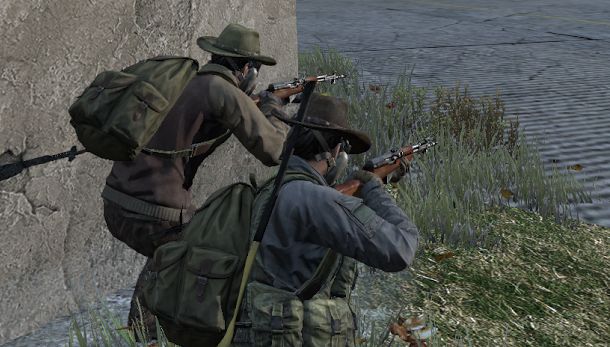
Give a concise and clear alert message that you have spotted another survivor in the area. Try to include an approximate position and direction. Avoid using general terms such as “behind me”, “over there”, or “up ahead”. Your current position and forward facing direction are likely not known by other squad members.
Examples:
- “Contact! I hear someone talking nearby. It sounds like it’s coming from the two-story green house.”
- “Contact! I see two survivors coming in from the sunny side of town!”
- “Contact! There’s a single player running west down the road on the coast near the restaurant.”
Provide a Description to the Squad

Giving an accurate description of the survivor(s) to your squad will help each squad member determine their best course of action. You would naturally want to approach contact with a fresh spawn differently than you would approach contact with a fully geared, camouflaged survivor carrying heavy weapons.
Your description will also allow your squad to be able to determine if any additional survivor contacts they make are the same or different than your survivor contact.
Examples:
- “She’s a fresh spawn with a baseball bat talking to another fresh spawn.”
- “They look like they are wearing helmets and carrying rifles. Green and purple backpacks.”
- “He’s fully kitted with camouflage and an automatic rifle in hand.”
Threat Assessment
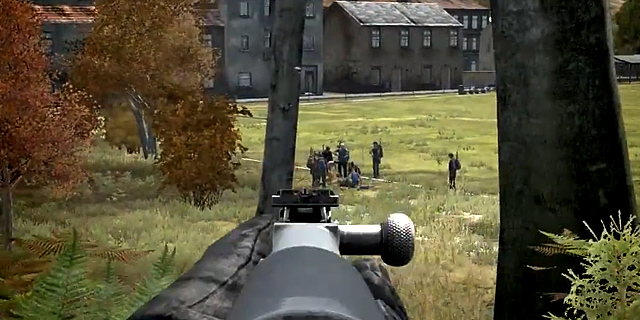
Work together to determine the threat level of the situation before continuing. Try and determine the motives of the survivor contact(s). Do they appear to be looting back and forth between buildings or moving in a single direction with a purpose? Are weapons readied? Were shots fired recently?
Be prepared for immediate action! Your squad leader should be able to provide direction based on the information received from the squad members that spotted or heard the contact. Following the direction of your squad leader and acting as an organized unit will prevent a stressful situation from turning into chaos.
Do not aim your weapon until you are prepared to shoot your target! During the diplomacy stage of an encounter, the Leader should be telling other survivors to keep their weapons down. Aiming is the same as shooting and will escalate the threat level immediately to a High Level Threat. Diplomacy has failed when a survivor draws and aims a weapon at a squad member.
Treat any survivors aiming at a squad member as an active shooter and eliminate them immediately, do not wait for an order to shoot. There may be encounters with survivors that are scared and waving guns around, their respawn should be their lesson to keep their gun muzzle down. Should a survivor need to be eliminated due to aiming and not shooting, politely inform them to keep their gun down and pointed in a safe direction next time until they are prepared to shoot. Practice aiming and shooting from a muzzle-safe stance to be able to react quickly to hostile forces aiming at the squad.
Unknown or Low Level Threat
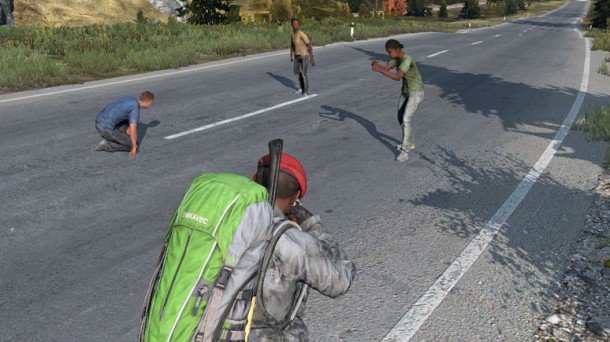
Examples of unknown or low level threats include fresh spawns, solo or small groups of survivors without weapons in hand, and solo well geared survivors without weapons in hand.
Low level threats are sometimes encountered while being attacked by infected. This is an excellent time to establish a friendly environment by helping the survivor.
Use verbal communication to initiate contact that is confident and reassuring to the unknown survivor that you are not a threat and to stop moving. Example: “Hello! I’m not going to harm you, I spotted you a while ago and wanted to say ‘Hi’.” Sometimes it helps to say something like: “I saw you a while ago, if I wanted you dead that would have already happened.” Another way to establish that you are helpful would be to say: “Do you need anything? Food, water, etc.”
Try to avoid using assumptive language. Assumptive language would be short words or descriptions that require someone else to trust you and assume your motives. Imagine if some stranger said these words to you, you would likely immediately be on your guard. The following words and phrases should be avoided because they can trigger unpredictable behavior in other survivors:
- I’m friendly!
- Are you friendly?
- Don’t shoot!
- I’m a hero.
- My gun isn’t loaded/no ammo.
- I’m playing alone.
Once a pseudo-friendly and safe environment has been established, you may then proceed with having conversation. Squads should ask if the survivor needs any assistance such as food or warmth. Squads should also ask how and where the survivor was killed if they are a fresh spawn to locate bandit activity.
Say “Goodbye” if you are in a squad after you have offered assistance and received any valuable information. It is not recommended to escort or follow even low level threat survivors due to the chance that you will encounter hostile forces with an undisciplined survivor around, or worse, the survivor may be an accomplice to the hostile forces.
Medium Level Threat
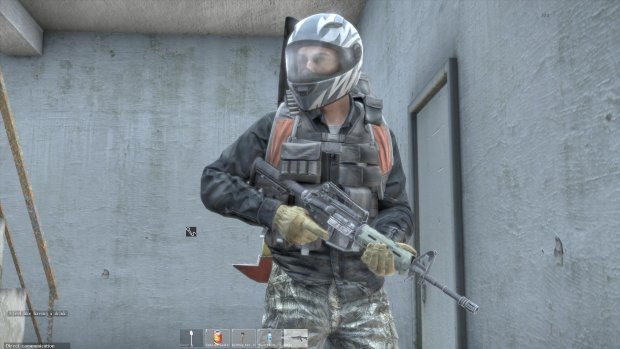
Examples of medium level threats include solo well geared survivors with a weapon in hand and groups of survivors that have visible melee or ranged weapons not in hand.
Squad members should be on high alert during medium threat encounters, especially with other groups of survivors. Your squad leader should be busy determining how and when to take actions, so be prepared to move and act quickly.
If your squad leader decides to initiate verbal contact, try and limit your exposure to the contact(s). The squad leader may not reveal that he is a member of a squad and exposing yourself to the survivors may put them on alert and risk your squad’s safety.
Squad members should generally behave as follows:
- (Leader) Decide whether to initiate contact based on current mission and circumstance. Determine “safe” zones and escape vectors and be ready to relay those directions to the squad. Use the “same as me” diplomacy method for weapons: if your weapon is out, don’t order the survivor to put their weapon away unless you put yours away first. Inform an armed survivor to keep their weapons down or put away with “same as me” diplomacy.
- (Medic) Stick with the squad leader and keep alert for suspicious activity.
- (Assist) Secure close perimeter activity and remain hidden if necessary. Should diplomacy fail with a survivor aiming at a squad member, inform the squad immediately if you decide to eliminate the threat. Be aware that you will be escalating the encounter to a High Level Threat with active combat and prepare for retaliation from other survivors.
- (Recon) Locate the squad as quickly as possible and relay a safe location behind cover. Be prepared to provide suppressive fire. Relay any additional information about the contact(s) such as location and direction. Be aware of any new perimeter contacts that appear to be part of the unknown survivor’s group.
High Level Threat
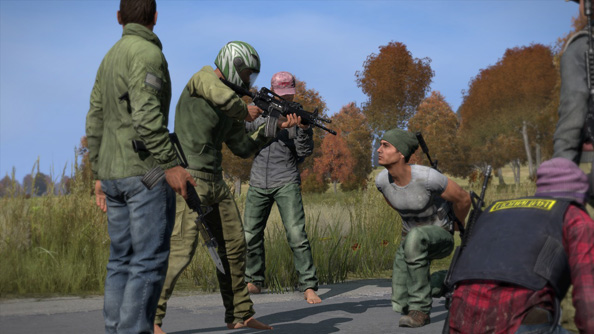
Examples of high level threats include any shots fired, being suddenly attacked during a lower level threat encounter, encountering well geared groups of survivors with firearms, and sudden encounters that surprise both parties.
If shots are fired at you and you are clearly the intended target, return fire immediately, even if you do not know the exact hostile position. This will put the hostile force into a defensive state, get their heart pumping, and they will be more likely to make mistakes under pressure.
The exact response to high level threats will vary greatly depending on the situation.
Squad members should generally behave as follows:
- (Squad) Be careful not to mistake innocent survivors for hostile forces!
- (Leader) Determine “safe” zones and escape vectors. Give clear and direct orders to the squad for movement and actions. If around other survivors, inform them to stay down until the threat is eliminated.
- (Medic) Stick with the squad leader. Be prepared to react to squad casualties and be prepared to veto squad leader’s movement commands if a squad member is injured and needs assistance.
- (Assist) Return fire immediately upon detecting hostile forces during the encounter. Offer to flank an entrenched hostile force with another squad member once the hostile location is known. Be prepared to locate and assist the Recon if necessary.
- (Recon) Determine the location of the high level threat. Be prepared to fire upon hostile forces to protect the mobile squad and provide suppressive fire.
